
Peptide Engineering: How Researchers Build Molecules
Building Blocks of Modern Science
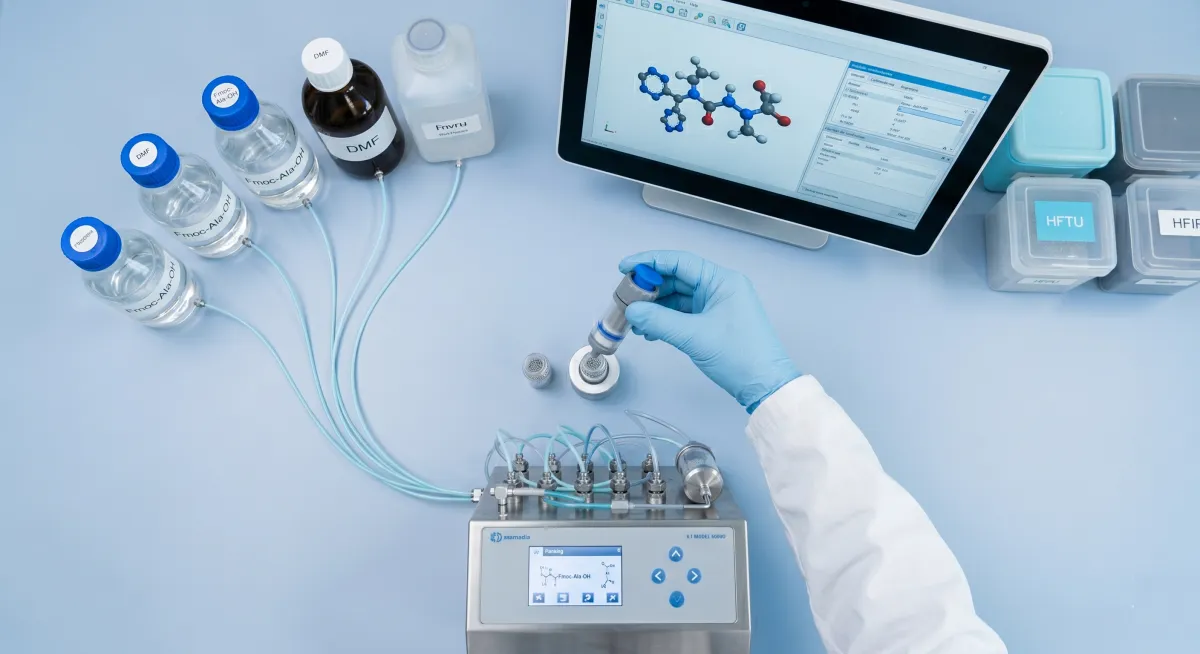
Peptides are at the heart of countless research breakthroughs. But how are they actually made? Peptide synthesis is the process of assembling amino acids into precise chains, creating molecules that can be studied, validated, and applied in scientific research. At HELIX Source, synthesis is more than chemistry — it’s the foundation of reproducibility and compliance.
The Science of Peptide Synthesis
Peptide synthesis typically uses solid‑phase methods, where amino acids are added step by step to a growing chain anchored to a resin. Protective groups ensure that only the desired bonds form, while solvents and reagents guide the reaction. Once complete, the peptide is cleaved from the resin and purified, often using HPLC or mass spectrometry.
Why It Matters
Precision: Ensures correct amino acid sequence.
Purity: Supports ≥99% purity standards for research peptides.
Scalability: Enables production of peptides for diverse applications.
Compliance: Guarantees reproducibility across labs and studies.
Research Impact
By mastering synthesis, HELIX Source provides peptides that meet the highest scientific standards. Every batch is linked to QR‑coded Certificates of Analysis, offering transparency on sequence, purity, and handling.
Looking Ahead
Advances in synthesis technology continue to improve efficiency, reduce errors, and expand the range of peptides available. HELIX Source remains committed to adopting these innovations, ensuring researchers have access to reliable, science‑forward compounds.
References
Merrifield, R.B. (1963). Solid Phase Peptide Synthesis. Nature.
Chan, W.C., & White, P.D. (2000). Fmoc Solid Phase Peptide Synthesis: A Practical Approach. Oxford University Press.
Bodanszky, M. (1993). Principles of Peptide Synthesis. Springer.
For Research Use Only – Not for Human or Animal Use. The contents of this article is for educational and informational purposes only.

