
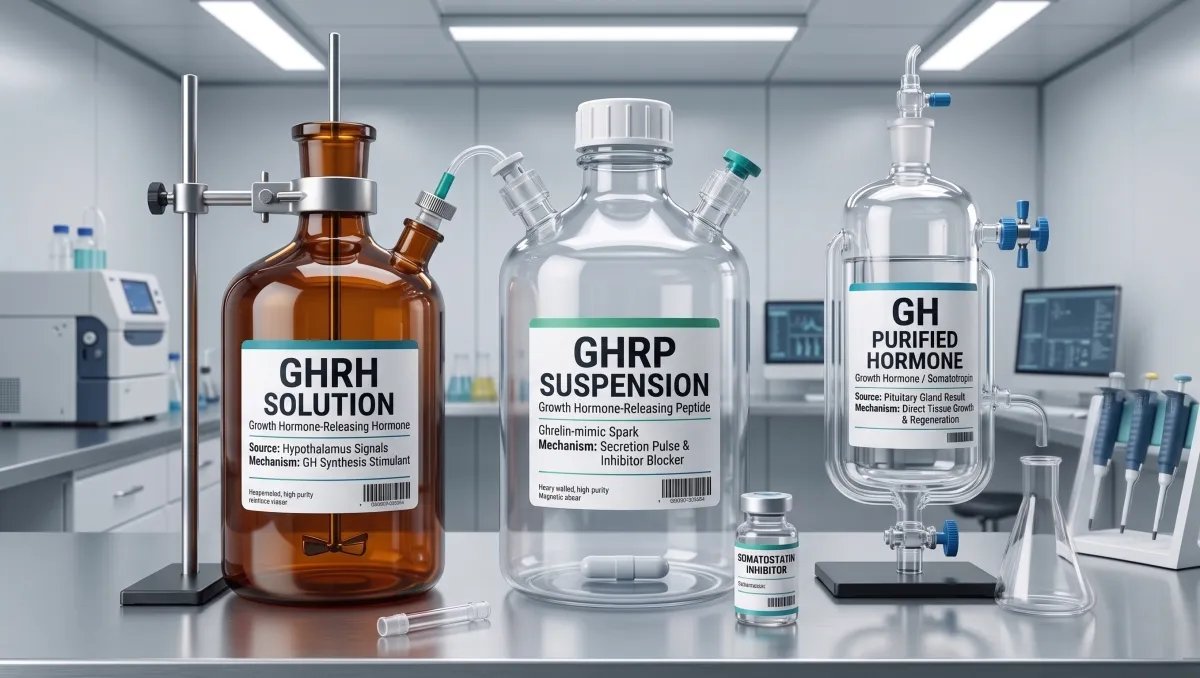
Growth Hormone, GHRH, and GHRP: Comparing Their Roles in Peptide Science
Understanding the Growth Hormone Axis
Growth hormone (GH) and its related peptides — GHRH (Growth Hormone‑Releasing Hormone) and GHRP (Growth Hormone‑Releasing Peptide) — form a complex network that regulates growth, metabolism, and cellular repair. At HELIX Source, understanding how these molecules differ helps researchers interpret peptide data accurately and design experiments with precision.
Growth Hormone (GH): The Effector
GH is the primary hormone produced by the pituitary gland. It acts directly on tissues to stimulate growth, protein synthesis, and metabolic regulation. In research, GH is often studied for its role in muscle development, fat metabolism, and cellular regeneration. It represents the end‑point effector of the growth axis — the molecule that carries out the biological response initiated by upstream signals.
Growth Hormone‑Releasing Hormone (GHRH): The Initiator
GHRH originates in the hypothalamus and signals the pituitary to release GH. It’s a natural peptide that controls the timing and amplitude of GH secretion. In laboratory studies, GHRH analogs are used to explore neuroendocrine signaling and pituitary responsiveness. It’s the initiator of the cascade — setting the rhythm for GH release through receptor activation.
Growth Hormone‑Releasing Peptides (GHRPs): The Amplifiers
GHRPs are synthetic peptides that stimulate GH release through a different receptor pathway — the ghrelin receptor (GHS‑R). They act synergistically with GHRH, amplifying GH secretion beyond baseline levels. Research on GHRPs focuses on their potential to modulate appetite, metabolism, and recovery processes. They serve as amplifiers, enhancing the natural GH response through receptor cross‑talk.
Why It Matters
As peptide science advances, new analogs of GHRH and GHRP are being developed to refine GH modulation. HELIX Source continues to monitor these innovations, integrating verified data into our research library to support transparent and reproducible science.
Looking Ahead
Advances in peptide synthesis and protein modeling continue to refine how researchers study molecular interactions. HELIX Source remains committed to integrating these discoveries into our workflows, ensuring every peptide we produce reflects the latest scientific understanding.
References
Giustina, A., et al. (2008). Growth hormone and its releasing factors: physiology and clinical implications. Endocrine Reviews.
Bowers, C.Y. (1998). Growth hormone‑releasing peptides: basic and clinical studies. Endocrine.
Thorner, M.O., et al. (1990). Regulation of growth hormone secretion by GHRH and GHRP. Journal of Clinical Endocrinology & Metabolism.
For Research Use Only – Not for Human or Animal Use. The contents of this article is for educational and informational purposes only.

